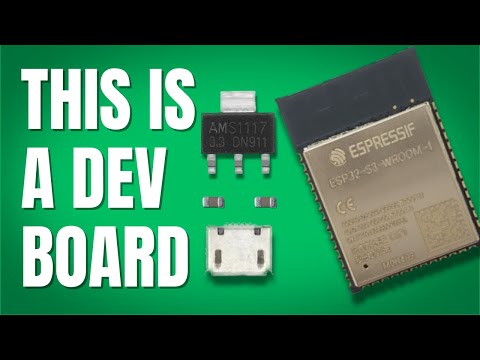
1 Minimalist Microcontroller: Building a Bare-Bones Dev Board
Pointed to as a demonstration of how few parts an ESP32-S3 board really requires, including programming over its built-in USB, when designing a custom board.
Channel
9 recommended videos. Channel on YouTube
Pointed to as a demonstration of how few parts an ESP32-S3 board really requires, including programming over its built-in USB, when designing a custom board.
Recommended for sampling analogue audio on an ESP32 at high rates, by reading the internal ADC through the I2S peripheral with DMA.
Pointed to as proof that an ESP32 can recognise a handful of spoken commands, and as a starting project for machine learning on microcontrollers.
The go-to example for anyone wanting walkie-talkies built from a microcontroller, with voice over ESP32 and project code available on GitHub.
Suggested for anyone stuck on ESP32 audio, showing a recorder that saves mono sound at high sample rates to an SD card, from a well-regarded channel.
Recommended for connecting digital MEMS microphones to an ESP32 over I2S, including a timing quirk of the SPH0645 that the INMP441 avoids.
Recommended for its real-world range testing of ESP-NOW, comparing normal and long range modes, which helps decide whether the protocol can cover a given distance.
Treated as a useful entry in a series on designing your own ESP32 board, showing how few parts a working circuit can need.
Shared as an example of playing audio through the ESP32 built-in DAC, and also as a way to judge how rough that output sounds.


